Web Hosting for Developers (2026): VPS vs PaaS, Priced at Three Sizes
For most developers the best web hosting is an unmanaged VPS: $5 to $6 a month buys a 1 GB Linux server with root access at DigitalOcean or Vultr, billed by the hour or second, with nothing between you and the stack you want. A PaaS such as Render or Heroku is the right call when you'd rather pay more per gigabyte than patch a server. Shared hosting suits developers only for PHP sites where you never need root.
This guide is for developers deploying their own apps, APIs and side projects: Node, Python, Rails, PHP or .NET. It prices the same app at three sizes on a VPS and on a PaaS, so you can see where the convenience premium starts to bite. If your whole project is a static site, skip to the stack section; you may not need a server at all. All prices are USD list prices read on 9-10 October 2026.
What developers need from a host
A developer's checklist looks different from a site owner's. Root or at least SSH access comes first, because without it you can't install a runtime, run a background worker or debug at the process level. Git-based deploys matter next, either built in (every PaaS) or set up yourself on a VPS with a CI pipeline. After that come a staging copy you can break safely, a managed or self-run database you can back up and restore, readable logs, and an API so servers can be created from code rather than a dashboard.
Billing granularity is the developer-specific detail most roundups skip. DigitalOcean has billed Droplets per second since 1 January 2026, with a minimum of 60 seconds or $0.01, and Vultr publishes an hourly rate for every plan, so a test server that lives for an afternoon costs cents. Transfer pricing matters for anything that serves files: DigitalOcean pools each Droplet's transfer allowance across your team and charges $0.01 per GiB over it, while Render's free Hobby workspace includes 5 GB of bandwidth a month and charges $0.15 per GB after that.
Three hosting models compared
Each model moves the line between what you manage and what you pay someone else to manage. The table shows the entry price and what stays on your plate.
| Model | Examples and entry price | You manage | Watch for |
|---|---|---|---|
| Unmanaged VPS | DigitalOcean 1 GiB $6; Vultr 1 GB $5; Hostwinds 1 GB $4.99; Lightsail 1 GB $7 | OS updates, firewall, runtime, database, backups | Your time; backups are usually extra (DigitalOcean: 20% of the Droplet price, weekly) |
| PaaS | Render web service $7 + Postgres from $6; Heroku Basic dyno $7 + Postgres $5; Railway Hobby $5 minimum usage; DigitalOcean App Platform container $5 | Code, config, environment variables | Price per GB of RAM climbs fast; free tiers sleep or expire |
| Managed VPS | ScalaHosting managed Build #1 $29.95 for 12 months, then $54.95 | Your app; the host patches and monitors the OS | Renewal price; plan specs set by slider |
Shared hosting is missing from the table on purpose. It can run a PHP app and often a Git deploy hook, but it rarely allows long-running processes, custom runtimes or root, which rules it out for most of what developers build. If your project is a WordPress or Laravel site and you never need a shell beyond the basics, shared hosting works; for anything else, the comparison is between the three rows above. Our VPS vs shared hosting breakdown covers that boundary in detail.
Same app, three sizes: the monthly cost
To compare like with like, we priced one web app with a Postgres database at three sizes. Small means about 1 GB of memory in total, enough for a side project or an internal tool. Medium means a 2 GB app with a 1 GB database, and large means a 4 GB app with a 4 GB database. On a VPS, the app and database share one server sized to the total; on Render, each is a separate service, plus 10 GB of database storage at Render's $0.30 per GB, which we've counted as a monthly charge on all 10 GB. Render also lists 1 GB of storage as included, so the true storage line may be 30 cents lower.
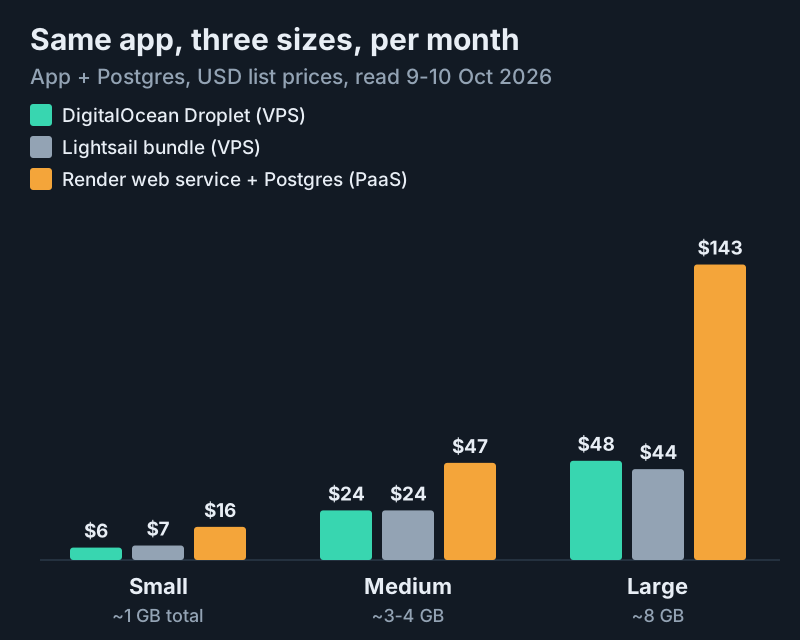
The working: DigitalOcean's Basic Droplets cost $6 for 1 GiB, $24 for 4 GiB with 2 vCPUs and $48 for 8 GiB with 4 vCPUs. Lightsail's bundles with a public IPv4 address cost $7 for 1 GB, $24 for 4 GB and $44 for 8 GB, each with transfer included. On Render, the small app is a $7 web service (512 MB) and a $6 Postgres instance (256 MB); medium is $25 (2 GB) and $19 (1 GB); large is $85 (4 GB, 2 CPU) and $55 (4 GB, 1 CPU). Add $3 of storage to each and you get $16, $47 and $143.
The gap widens with size: at small scale the PaaS premium is about $10 a month, the price of not managing a server. At large scale it's about $95 a month against DigitalOcean. Heroku makes the step steeper still: its smallest dyno with at least 2 GB of memory is Performance-M at $250 a month, because the Standard dynos stop at 1 GB. Railway bills by usage instead, at $0.00000386 per GB of memory per second and $0.00000772 per vCPU per second, which works out at about $10 per GB and $20 per vCPU for a 30-day month by our arithmetic, with the Hobby plan's $5 minimum covering the first $5.
None of this makes PaaS a bad deal. The premium buys automatic deploys from Git, managed TLS, zero-downtime restarts, and a database somebody else patches and backs up. For one developer with a small app, $10 a month is a fair price for those hours. As apps grow, teams with someone who already runs Linux often move the biggest services to servers they manage, where the same memory costs a third as much.
By stack: Node, Python, Rails, PHP and .NET
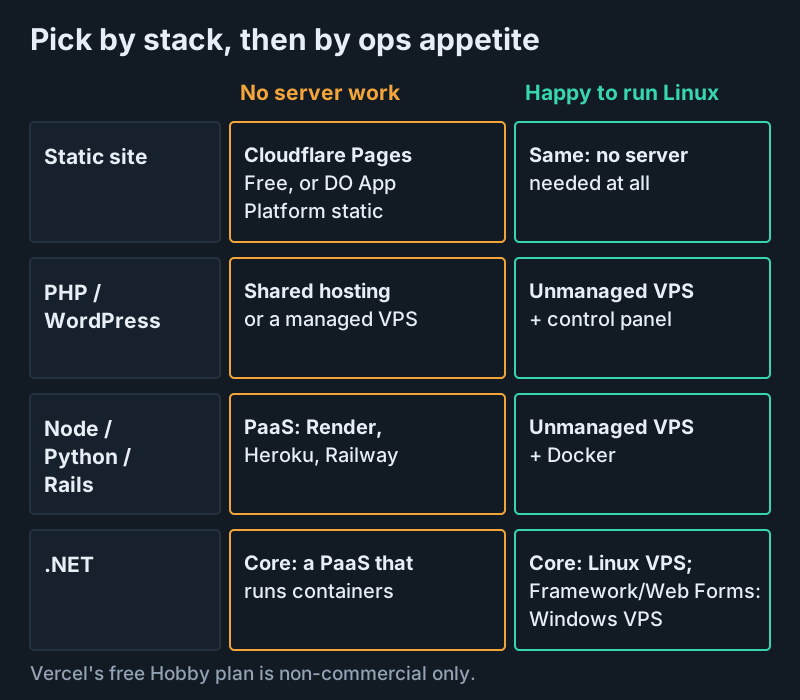
Node, Python and Rails apps are long-running processes, which is exactly what shared hosting is bad at and what both a VPS and a PaaS do well. On a PaaS you push code and the platform detects the runtime. On a VPS, the cleanest setup is Docker with a reverse proxy in front, so the app, its dependencies and the database version are pinned in files you can rebuild anywhere. Our VPS for Docker and Node guide walks through that setup.
PHP and WordPress is the one stack where shared hosting still competes, because shared hosts are built around PHP and MySQL. Choose a VPS when you need a newer PHP version than your host offers, background queues, or the freedom to tune PHP-FPM and caching. A control panel on the VPS gives you the shared-hosting experience back; ScalaHosting includes its SPanel panel at no licence cost.
.NET splits in two. ASP.NET Core is cross-platform and runs on Linux, so any Linux VPS or a PaaS that runs containers will host it. .NET Framework apps, including ASP.NET Web Forms, need Windows, so they need a Windows VPS. On Hostwinds, for example, the 1 GB Windows VPS costs $16.99 against $4.99 for Linux, because the licence is in the price.
Static sites don't need a server at all. Cloudflare Pages and DigitalOcean App Platform both host static sites free (App Platform allows three static-site apps on its free tier). One caution if you're tempted by Vercel: its free Hobby plan is for non-commercial use only, and Vercel's terms class client projects, advertising, selling and affiliate-first sites as commercial.
Our picks for developers
These picks rank on what a developer pays per unit of control, with prices dated. They aren't ordered by commission: Render and Lightsail aren't partners of this site and appear on merit, while we may earn from the VPS providers linked below.
DigitalOcean: the default for most developers
DigitalOcean is the safest first VPS for a developer: $6 a month for 1 GiB, 1 vCPU and 25 GiB, per-second billing, pooled transfer with $0.01 per GiB overage, and a large library of tutorials and documentation. Its App Platform gives you a PaaS-style path on the same account, from $5 a month for a container, so a project can start as a pushed app and move to a Droplet later. Backups cost extra, 20% of the Droplet price for weekly or 30% for daily.
Affiliate link. We may earn a commission — it never moves a ranking.
Vultr: hourly billing across 31 locations
Vultr's regular 1 GB plan costs $5 a month, or $0.007 an hour, and is available in 31 locations according to its public plans API. The High Frequency line adds NVMe storage from $6 a month for 1 GB. Choose it when you need a server close to users in a region other providers don't cover, or want to spin up short-lived boxes by the hour.
Affiliate link. We may earn a commission — it never moves a ranking.
Hostwinds: flat pricing and a Windows option
Hostwinds charges one flat monthly price, $4.99 for a 1 GB Linux VPS with 30 GB and 1 TB of transfer, with no intro price that jumps later. It also sells Windows VPS plans, from $16.99 a month for 1 GB, which makes it a practical option for .NET Framework work.
Affiliate link. We may earn a commission — it never moves a ranking.
ScalaHosting: when you want the server managed
ScalaHosting's managed VPS starts at $29.95 monthly for a 12-month first term, then $54.95; its self-managed cloud VPS starts at $19.95 and renews at $24.95. The managed plans include SPanel and a team that patches the OS, which suits agencies and PHP developers who want root-level resources without being the sysadmin. Read the renewal price before committing to the term.
Affiliate link. We may earn a commission — it never moves a ranking.
Render and Lightsail, on merit
Render is the cleanest PaaS we priced: a free tier for experiments, $7 for an always-on 512 MB service, and Postgres from $6. Lightsail is AWS's flat-priced VPS, $7 for 1 GB with a public IPv4 address and transfer bundled, and it's the easy on-ramp if you'll later need other AWS services. Neither is a partner of this site. For a fuller ranking of plain VPS providers, see our best VPS hosting guide.
Free tiers and other edge cases
Free tiers sleep. Render's free web services spin down after 15 minutes without traffic and take about a minute to wake. Heroku ended its free plans on 28 November 2022; its cheapest Eco dynos ($5) also sleep after 30 minutes of inactivity and are for personal accounts only. Railway's free plan starts with a 30-day trial and $5 of credit, then gives $1 of usage a month. Fine for demos, not for anything a user waits on.
Cloud free trials end. AWS lists 750 free hours a month on its t4g.small instance until 31 December 2026. Put a calendar reminder on any free-trial server, because it starts billing at list price when the trial ends.
Ops time is the hidden cost of a VPS. An unmanaged server needs updates, a firewall and tested backups. Our securing a new VPS checklist covers the first hour; after that, unattended security updates and a monthly restore test keep it honest. If nobody will do that, the PaaS premium is cheaper than an incident.
Egress at scale. Bandwidth rarely matters for an API, but it dominates for media-heavy apps. Compare the included transfer (1,000 GiB on DigitalOcean's $6 Droplet, 1,024 GB on Vultr's $5 plan, 5 GB on Render's Hobby workspace) before you pick a host for a file-serving app. Railway charges $0.05 per GB of egress.
Sources (read 9-10 Oct 2026): Render pricing, Render free tier docs, Heroku pricing, Railway pricing, Amazon Lightsail pricing, AWS T4g instances, choosing .NET for server apps; pricing pages from DigitalOcean, Vultr (public plans API), Hostwinds and ScalaHosting.
Web hosting for developers: common questions
What is the best web hosting for developers?
Is shared hosting good enough for a developer?
What is the cheapest way to host a Python or Node app?
Is a PaaS more expensive than a VPS?
Do I need Windows hosting for .NET?
Put this in context: the best VPS hosting, ranked, or VPS vs dedicated vs cloud.