VPS vs Shared Hosting (2026): When the Upgrade Pays, With Real Prices
Shared hosting rents you space on a server that hundreds of other accounts use, behind a control panel and a set of usage caps; a VPS gives you a fixed slice of a machine, with your own operating system and root access. The price gap is smaller than the sticker suggests. Shared plans start near $3 a month but renew at about $11, while a 1 GB unmanaged VPS costs $4.99 to $6 monthly with no renewal jump (prices read 9-10 October 2026).
The short verdict: stay on shared hosting if you run a standard WordPress or PHP site and nobody wants to touch a terminal. Move to a VPS when you need custom software, keep hitting resource limits, or want performance that doesn't depend on your neighbours. If you want VPS resources but not the admin work, a managed VPS exists, at roughly five to eleven times the price of a 1 GB unmanaged plan.
The difference in one sentence
On shared hosting you get a share of a server's capacity up to a cap; on a VPS you get an allocation that is reserved for you, plus the keys to the whole operating system. Everything else follows from that. Shared hosting decides your software stack, patches the server and limits how much CPU you can burn. A VPS lets you choose the stack, run any process you like and use every bit of the RAM you're paying for, and hands you the patching in return. Our what is a VPS primer covers how the virtualization itself works.
Resources and the noisy neighbour
The table below puts real plan specs side by side. Read the shared rows carefully: those numbers are ceilings the host enforces, not resources set aside for you. The VPS rows are allocations your virtual machine gets whether the neighbours are busy or not.
| Plan | Type | CPU | RAM | Storage | Price per month |
|---|---|---|---|---|---|
| Hostinger Premium | Shared | 1 core (cap) | 2 GB (cap) | 20 GB SSD | $2.99 on 48 mo, then $10.99 |
| Hostinger Unlimited | Shared | 2 cores (cap) | 3 GB (cap) | 50 GB NVMe | $3.99 on 48 mo, then $16.99 |
| SiteGround StartUp | Shared | 1,000 CPU-seconds/hour | Not published | 10 GB | $2.99 for 12 mo, then $17.99 |
| IONOS VPS S+ | Unmanaged VPS | 1 vCore | 2 GB | 60 GB NVMe | $2 for 3 mo (1-yr term), then $6 |
| Hostwinds Linux 1 GB | Unmanaged VPS | 1 CPU | 1 GB | 30 GB | $4.99 flat |
| Vultr Regular | Unmanaged VPS | 1 vCPU | 1 GB | 25 GB | $5 flat |
| DigitalOcean Basic | Unmanaged VPS | 1 vCPU | 1 GiB | 25 GiB | $6 flat |
Shared hosting limits show up in more places than CPU and RAM. Hostinger caps Premium at 40 PHP workers and 400,000 inodes (files and folders); SiteGround's fair-use rules give StartUp a CPU budget of 1,000 seconds per hour (10,000 daily, 300,000 monthly) plus 200,000 inodes. Go over and the host throttles you, or asks you to upgrade. Those caps exist because one busy account can slow everyone else on the box, the noisy-neighbour problem. A VPS's hypervisor reserves your RAM, so a neighbour's traffic spike can't take it from you, though entry VPS plans usually share physical CPU cores, so a little contention remains.
One note on the cheapest VPS of all. Hetzner's CX23 lists at €5.49 a month excluding VAT and before the €0.50 primary IPv4 charge, up from €3.99 before Hetzner's June 2026 price adjustment, and Hetzner's own product page marked it "currently unavailable" when we checked on 9 October. It's excellent value when you can get it, but we've left it out of the comparison until it's orderable again.
Price steps: shared renewal vs unmanaged vs managed VPS
The fair comparison is renewal against renewal, because that's what you pay from year two. Shared hosting's renewal cliff is steep: Hostinger Premium goes from $2.99 to $10.99, and DreamHost Launch from $2.89 for its first year to $10.99. Most unmanaged VPS providers charge one flat monthly price, so their year-two bill is their year-one bill. IONOS is the exception in our table, with $2 a month for three months on a one-year term, then $6.
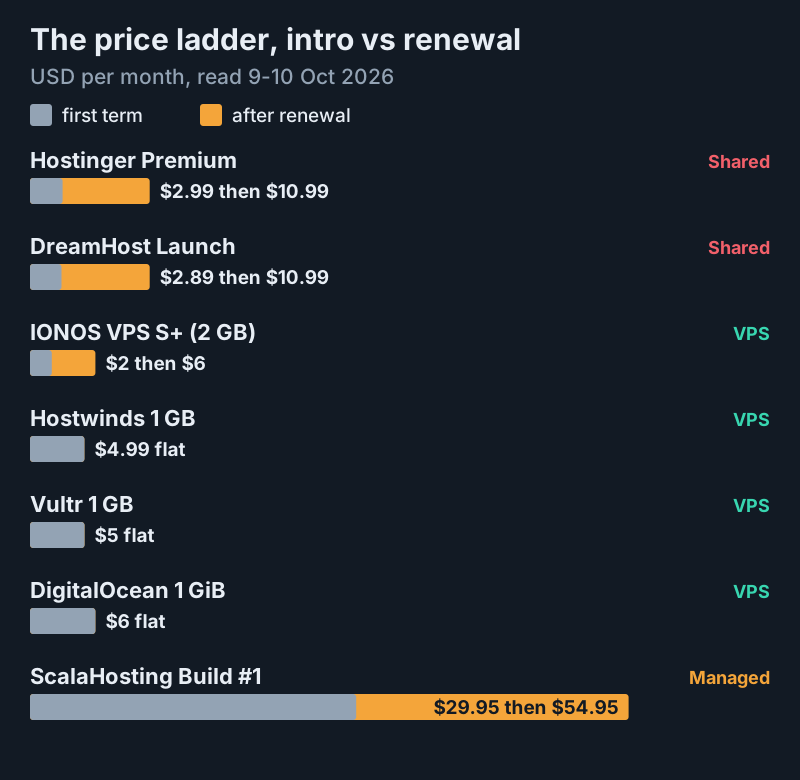
Managed VPS is a separate price class. ScalaHosting's managed Build #1 costs $359.40 for its first 12 months ($29.95 monthly), then $54.95 a month, with its SPanel control panel included at no licence cost. Its self-managed cloud Config #1 is $19.95, renewing at $24.95. You're paying for a support team that patches and monitors the server, which is worth it if the alternative is nobody doing that job. If you'd rather keep the managed safety net, ScalaHosting is the managed option we price here.
Three-year cost: closer than it looks
Spread over three years, an entry VPS often costs less than the shared plan people reach for first. The chart sums 36 months at the prices above, without tax.
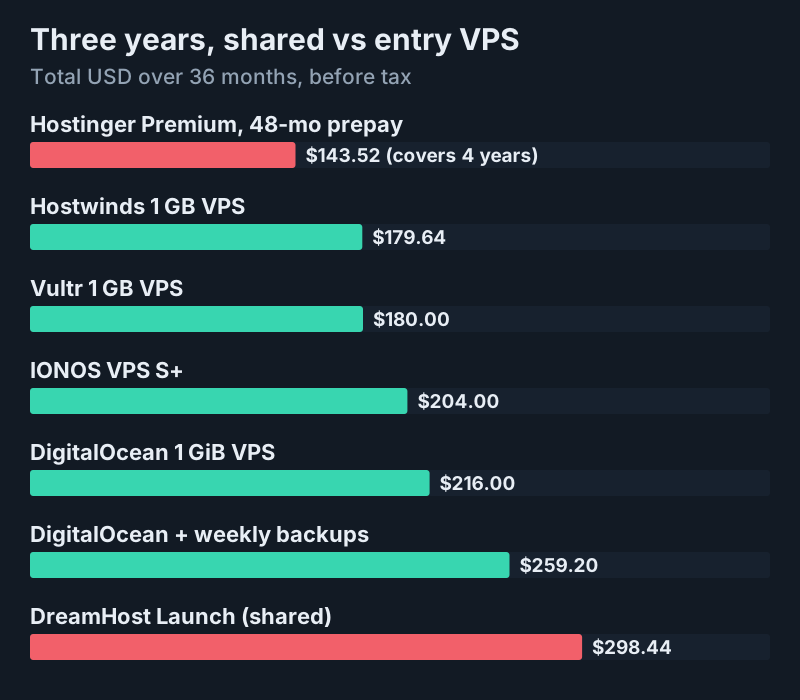
The arithmetic: Hostwinds is 36 × $4.99 = $179.64; Vultr 36 × $5 = $180; IONOS is three months at $2 and 33 at $6, or $204, if the renewal price holds; DigitalOcean is 36 × $6 = $216, or $259.20 with its weekly backups, which cost 20% of the Droplet price. DreamHost Launch is 12 × $2.89 plus 24 × $10.99, or $298.44. Hostinger's 48-month prepay is the outlier at $143.52 for four years, but you hand over the whole sum upfront and its included email stops being free after year one.
So price alone rarely decides it. A shared plan bought on a long prepaid term is cheap; a shared plan bought for one year and renewed is not. If cost is the main question, our cheapest reliable VPS guide goes deeper on the budget end, and if you're ready to compare providers, Hostwinds and DigitalOcean are the flat-priced 1 GB plans in the chart.
Root and control
Root access is the practical difference you'll feel first. On a VPS you can install any language runtime, run Node, Python or Go services as long-running processes, use Docker, set up background workers and cron jobs on your own schedule, open the ports you need and pick your Linux distribution. Shared hosting gives you what the host installed, usually PHP, MySQL and a control panel, and runs your code inside its limits. If your project is a standard CMS, that's a feature, not a restriction: fewer moving parts and nothing for you to break.
The trade is that a VPS arrives as a blank server. You choose the stack, configure the web server and set up TLS certificates yourself, or install a control panel to do it for you. Our guide to choosing VPS specs helps size the box, and the best Linux distro for a VPS covers the operating-system choice.
Signs you've outgrown shared hosting
These are rules of thumb, not hard thresholds; hosts measure usage differently and some are more forgiving than others. The clearest sign is the host telling you: emails about CPU or inode limits, an account suspended during a traffic spike, or a support agent suggesting an upgrade. The next is a software wall, when you need a runtime, a background worker or a database version the shared plan won't provide. A third is inconsistent speed that doesn't match your own traffic, which points to the server's other tenants.
Traffic on its own is a weaker signal than people think. DreamHost pitches Launch at roughly 40,000 visits a month and calls that figure a guide rather than a hard limit. How many visits any plan can serve depends heavily on caching and on how dynamic each page is, so a cached brochure site and a busy online store with the same traffic put very different loads on a server. Watch the resource emails, not the visitor count. Our when you need a VPS checklist walks through each signal in more detail.
Who owns security on each
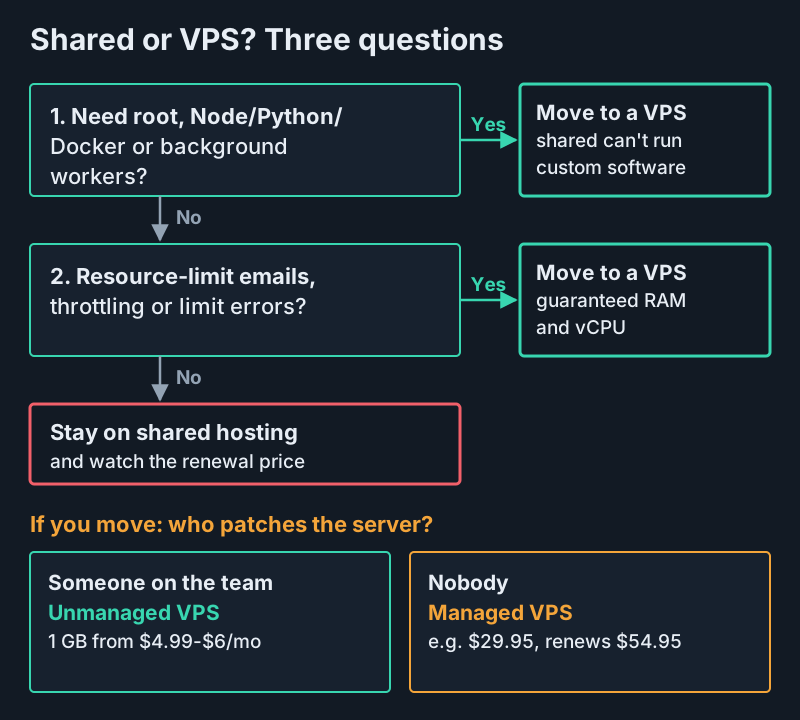
On shared hosting the provider patches the operating system, runs the firewall and usually scans for malware; your job is your CMS, its plugins and your passwords. On an unmanaged VPS all of that moves to you. That means applying OS updates, configuring a firewall, locking SSH to keys, and setting up backups, which many VPS providers sell as an add-on rather than include. It's an afternoon of setup and a few minutes a week after that, but it's real work, and an unpatched VPS is less safe than a well-run shared account. Our securing a new VPS checklist covers the first hour.
A managed VPS splits the difference: the provider handles OS patching, monitoring and usually the control panel, while you keep reserved resources. Read the scope carefully, because "managed" means different things at different hosts. Managed vs unmanaged VPS compares what each side typically covers.
Edge cases
Email. Shared plans usually bundle mailboxes; a bare VPS doesn't, and running your own mail server well is hard, because your server's IP reputation, SPF, DKIM and DMARC all have to be right. On a VPS, put mailboxes with a dedicated email provider and send app mail through a transactional email service.
Backups cost extra on most VPS plans. DigitalOcean charges 20% of the Droplet price for weekly backups or 30% for daily ones; snapshots are $0.06 per GB a month. Budget for this from day one; on shared hosting it's usually bundled.
Introductory VPS pricing. IONOS's $2 lasts three months on a one-year term before $6 applies, and ScalaHosting's managed and self-managed prices both renew higher. The flat-rate providers (Hostwinds, Vultr, DigitalOcean) don't have that cliff, but nothing stops any of them changing list prices later, as Hetzner did twice in 2026.
A bigger shared plan may be enough. If you've hit a CPU cap but need nothing else a VPS offers, the next shared tier up, or a host's cloud plan, can be the cheaper fix. Hostinger's Cloud Startup, for example, raises the caps to 4 cores and 4 GB for $7.99 monthly across a 48-month term, then $25.99.
Which should you choose?
Choose shared hosting for a standard website when nobody on the team wants to run a server, and buy it on a term whose renewal price you've already read. Choose an unmanaged VPS when you need root, custom software or reserved resources, and someone can spend an afternoon on setup and a few minutes a week on updates; at $4.99 to $6 a month for 1 GB, it's no more expensive than a renewed shared plan. Choose a managed VPS when you need VPS resources and nobody to look after them. Our best VPS hosting ranking compares the providers in detail.
Sources (read 9-10 Oct 2026): Hetzner price adjustment notice, Hostinger plan limits; pricing pages from Hostinger, DreamHost, SiteGround, IONOS, Hostwinds, Vultr (public plans API), DigitalOcean and ScalaHosting.
VPS vs shared hosting: common questions
Is a VPS better than shared hosting?
Is a VPS more expensive than shared hosting?
What is the difference between VPS hosting and web hosting?
When should I upgrade from shared hosting to a VPS?
Do I need technical skills to use a VPS?
Put this in context: the best VPS hosting, ranked, or VPS vs dedicated vs cloud.